
Ruger Holsters
Custom Kydex Ruger Holsters
Most manufacturers follow a simple rule: a new model name means a new holster. Ruger breaks that rule in both directions, which is why guessing goes wrong here more than anywhere else we build.
Half of these 8 configurations are pocket-sized, and their differences sit mostly in the grip — below where a shell does its work. Then there is the RXM, which shares its outline with nothing else Ruger makes. Ask before you assume, in either direction.
8
Ruger fitments
Ranging from a pocket .380 to a full-size 5.7, with very little in between.
4
Are pocket or micro
Half the catalogue, and the half where a shell has the least material to hold on to.
Grip
Where Ruger changes things
Which is largely beneath the surfaces Kydex grips, so family rules do not transfer.
RXM
The odd one out
A Ruger built on somebody else’s pattern, and the only one here raising cross-brand questions.
Fitment
Where Ruger Changes Things, and Whether It Reaches the Shell
Ruger’s revisions cluster around the grip: taller floorplates, thicker backstraps, more rounds in the same footprint. A shell takes its hold forward of the trigger guard and along the slide, so a great many of those changes never reach it — and a few of them reach it hard.
That is the opposite of the assumption most buyers arrive with. Find your gun below, and where a line says to check with us, please do.
Pocket .380s and Micro 9s
The reason most people know the name. These are the smallest pistols we press a pattern for, and the ones where a shell that is merely close gives you movement you can feel on the belt.
- LCP
- LCP Max
- LC9
- Max-9
RXM — Built to a Different Pattern
The newest gun in the line and the only Ruger here that invites a cross-brand comparison, because Ruger built it around an existing standard rather than one of its own.
SR9 — The Full-Size Generation
Ruger’s earlier duty-size striker guns, discontinued but still carried in numbers. Two sizes on one design, and enough weight between them to change where you mount the holster.
- SR9 Full Size
- SR9C — compact
5.7 — The Outlier
A long, light, high-capacity pistol in a cartridge almost nothing else here shares. Nothing about its proportions matches the rest of the range, so it is tooled entirely on its own.
- Ruger 5.7
Deep dive: the Ruger RXM holster page deals with the Glock-pattern question properly, including which Glock 19 shells actually work and which do not.
Two gaps worth knowing. There is no LCP II line in our selector and no Security-9 line at all. The LCP II differs from the original LCP through the grip and takes a different magazine, so if that is what you own, check with us first rather than ordering the plain LCP.
Sure which Ruger you have?
Pick the matching line, add your hand and any light, and the shell is pressed to that specific gun rather than its family.
Carry Style
Ruger Holsters by Carry Style
A pocket .380 and a full-size 5.7 have nothing in common as carry problems. Pick the mounting for the gun, not for the brand.
Ruger Sidecar Holsters
Ruger Bundles
Light & Optic Ready
Most of This Range Has Nowhere to Put a Light
Being blunt about it saves people money: an LCP and an LC9 have no accessory rail, so there is nothing to hang a light from and no shell we can press to include one. That is a property of the pistol, not a limitation of ours.
Where a rail does exist — the Max-9, the RXM, the SR9 pair and the 5.7 — the choice follows the frame size. A micro takes a compact body such as the TLR-7 Sub or a clamp-on TLR-6; the full-size guns will carry a TLR-1, an X300U or an Olight PL-2 without looking absurd.
Optics. The optic-ready guns in this line, chiefly the Max-9 and the RXM, take a slide-mounted micro dot and our shells for those are cut to clear a shielded housing. Say so when you order, and mention separately if you run taller irons to co-witness — those want the channel opened further than the optic alone.
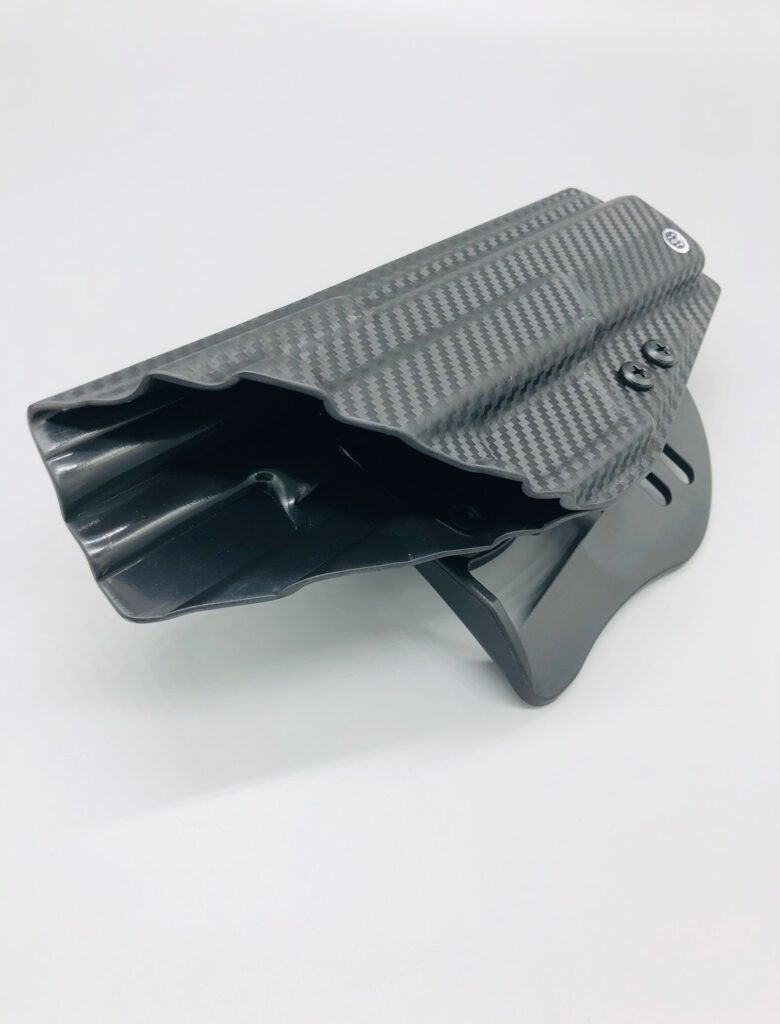
Pictured: a black carbon fiber paddle holster seen from the muzzle end.
Popular Builds
Ruger-Ready Holsters
Three builds that span this range, from a pocket .380 to the 5.7. Each presses to any Ruger line above once you name the model.
Triton Series IWB Holster
$50
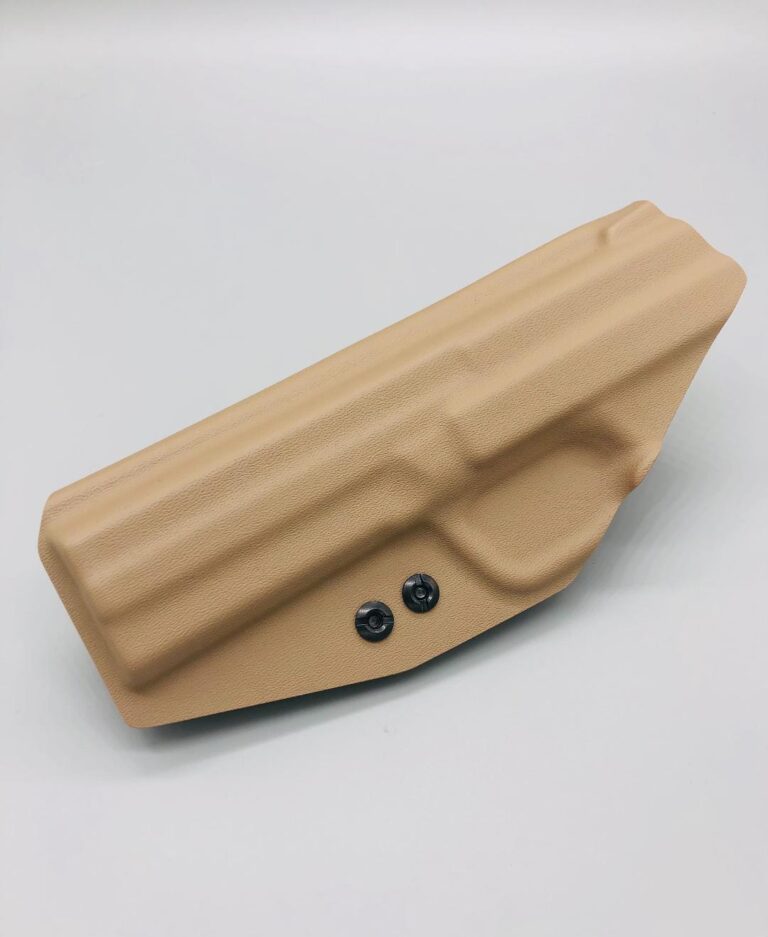
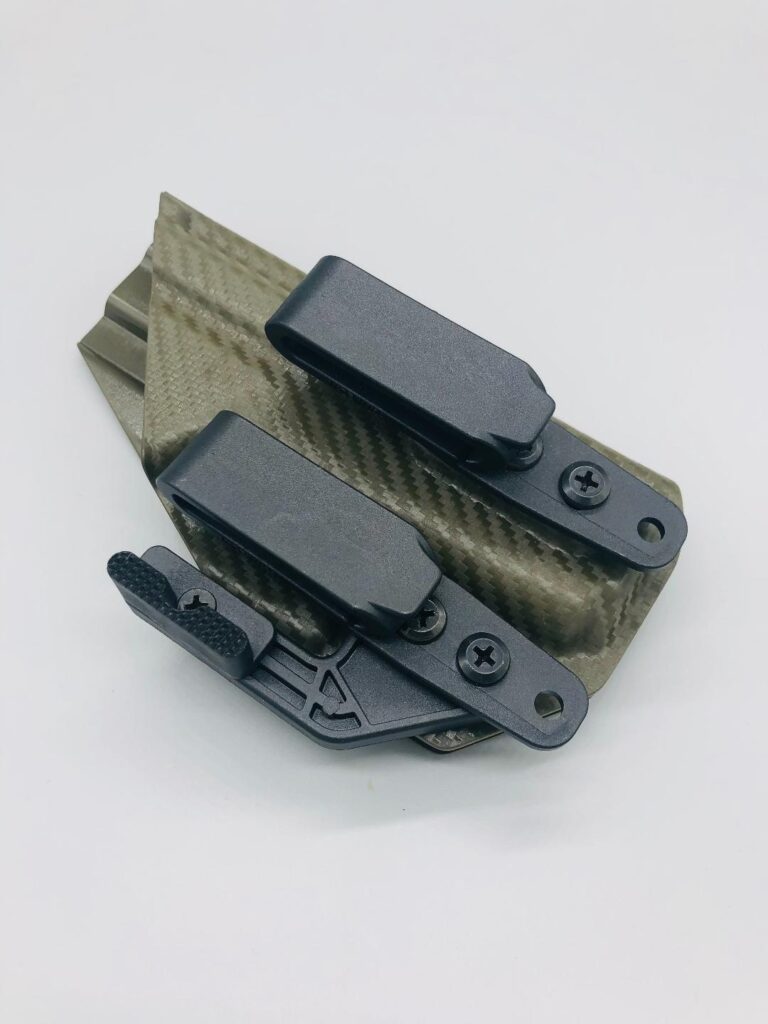
Minimal shell, one clip and adjustable tension — the least holster a pocket .380 can be given without giving up retention.
Proteus Series IWB Holster
$60
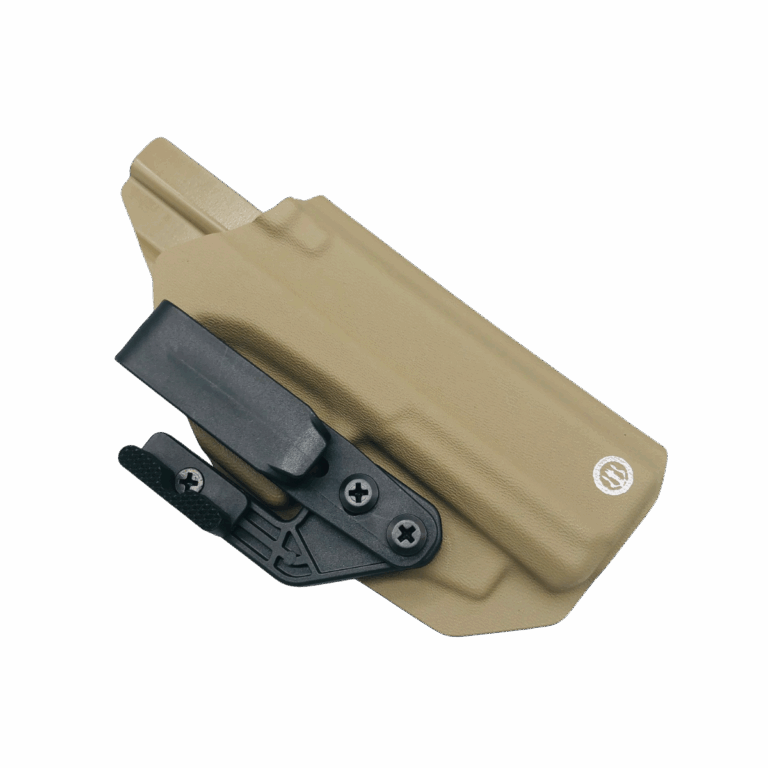
A deeper-riding inside-the-waistband build that drops a short grip further below the belt line for a flatter profile.
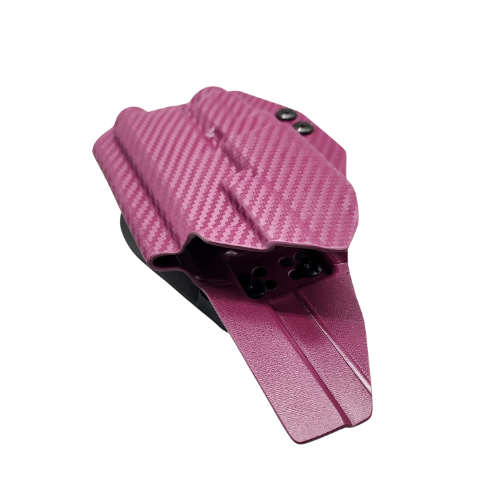
Chronos Series OWB Paddle Holster
$60
The sensible mount for a 5.7 or an SR9, spreading a long pistol across a broad paddle instead of one clip.
Why Neptune
Why We Ask Instead of Assuming on Ruger
The stock answer in this trade is to group a manufacturer into three or four shells and let tension screws cover the rest. On a line this varied — and this small at one end — that produces holsters which technically close and practically wobble. What we do instead:
- Pocket pistols are tooled individually rather than sorted into a small, medium and large, since a shell holding a five-inch gun has margin that a four-inch gun simply does not.
- A gun built to another manufacturer’s pattern gets its own mold anyway, because near-compatibility is exactly the situation where retention quietly goes wrong.
- Where a line is genuinely missing from our list, we tell you before you order rather than selling you the closest-looking option and hoping.
Cut and pressed to order in Middle Tennessee by a veteran-owned shop, one at a time. Who we are · all firearm brands we mold for.
FAQ
Ruger Holster Questions
Tell Us the Exact Ruger
Model, generation and any light or optic. On this brand the family name genuinely is not enough to go on, and we would rather ask than guess.