
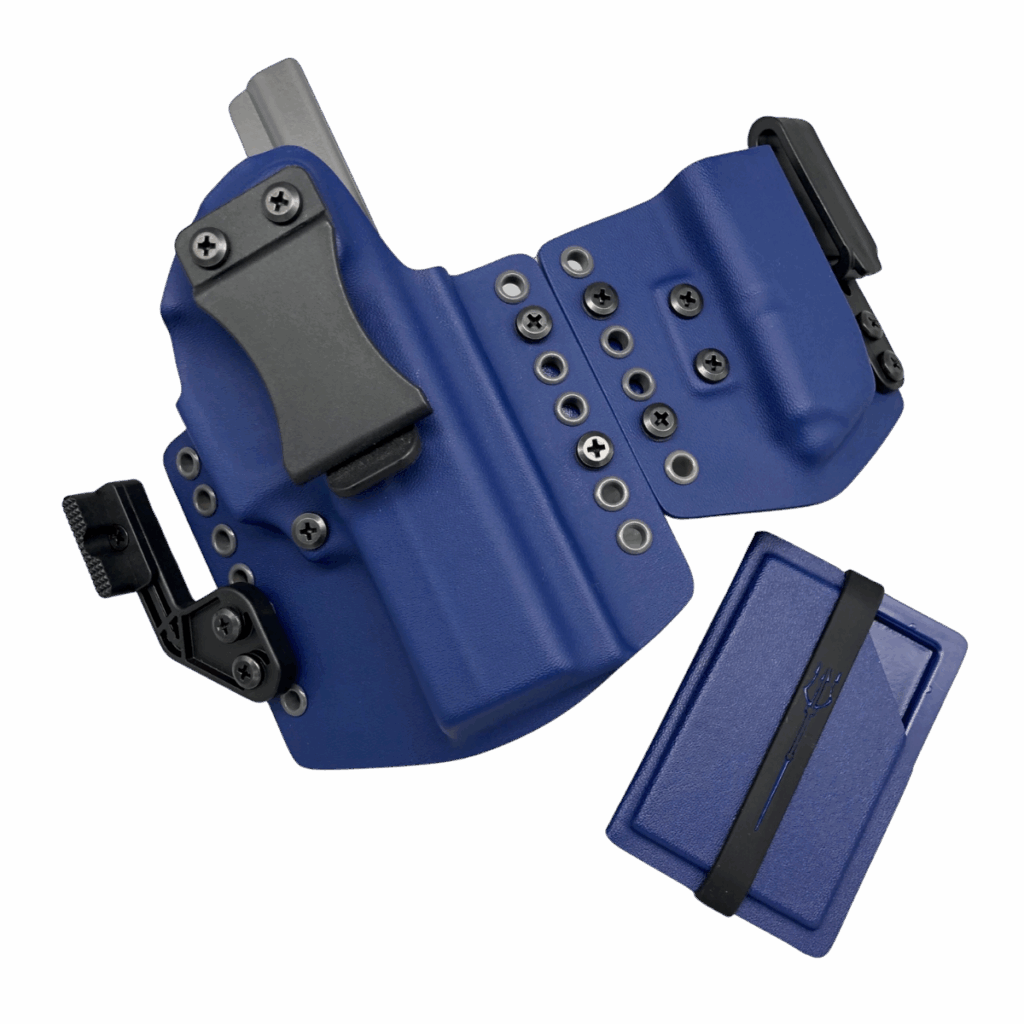
3 Neptune Concealment Gear Upgrades Every Daily Carrier Needs Right Now
The three concealed carry gear upgrades every daily carrier needs are a handmade IWB holster molded to your exact gun, a reinforced gun belt that won’t sag under the weight of your rig, and a dialed-in appendix carry setup with a claw and wedge to kill printing. Each one fixes a comfort or reliability problem that mass-produced, machine-cut gear simply can’t solve because it was never built for you in the first place.
Let me be straight with you. Most folks carrying every single day are doing it with gear that’s quietly working against them. They bought a holster off a peg hook at a big-box store, threaded it onto whatever belt was holding up their jeans, and called it good. Then they wonder why the gun digs into their hip by noon, why the grip prints through their shirt, and why they keep leaving the thing at home. If that sounds familiar, you’re exactly who I’m talking to — and the right concealed carry gear upgrades will change how you carry overnight.
I’ve been around guns and holsters long enough to know the difference between kit that looks good in a product photo and kit that earns its place on your body for sixteen hours straight. At Neptune Concealment we don’t run sheets of Kydex through a machine and pop out a thousand identical shells. We mold every holster by hand, to your firearm, with a lot of sweat and a few burned fingertips along the way. That difference matters more than you’d think, and I’ll show you exactly where.
Why Most Daily Carriers Are Walking Around With Gear That's Holding Them Back
Here’s the uncomfortable truth. A 2023 survey from the National Shooting Sports Foundation found that a huge share of permit holders carry far less often than they intend to, and the reasons people give over and over are comfort and concealment. Not lack of training. Not fear. Comfort. The gun’s too big, the holster bites, the belt sags, the grip shows. So the firearm stays in the safe, which makes it about as useful as a paperweight.
Mass-produced gear is built around averages. The factory designs for a “typical” waistline, a “typical” body, a “typical” draw. You are not typical. Nobody is. When a holster is cut to a template, it has to leave clearance so it’ll sort of fit the most people possible, and that slop is exactly what creates hot spots, sloppy retention, and printing. From what we’ve seen, the single biggest reason people quit carrying isn’t the gun — it’s gear that was never fit to their body in the first place.
Think about the last time you wore a pair of boots that almost fit. You dealt with it for a day, maybe two, then they lived in the closet. Your everyday carry gear works the same way. If it fights you, you’ll stop using it, and no amount of motivation fixes a fundamental fit problem. The fix isn’t more willpower. It’s better gear.
The 3 Concealed Carry Gear Upgrades That Actually Move the Needle
You could spend money on a dozen gadgets and gizmos that promise to revolutionize your carry. Skip most of them. In practice, three upgrades do the heavy lifting, and once you’ve got these three squared away, everything else is just fine-tuning around the edges.
The first is a holster that actually fits your gun and your body. The second is a belt built to carry a loaded firearm instead of just keeping your pants up. The third is the appendix setup — the claw, the wedge, the cant — that takes a decent rig and makes it genuinely disappear under a t-shirt. Get all three working together and you’ll forget you’re armed, which is the whole point.
None of these are exotic. What separates them from the stuff you’ve already tried is how they’re made and how they’re fit. A machine-cut holster and a hand-molded one might look similar in a thumbnail, but on your hip at hour twelve they feel like different planets. Let’s break each one down.
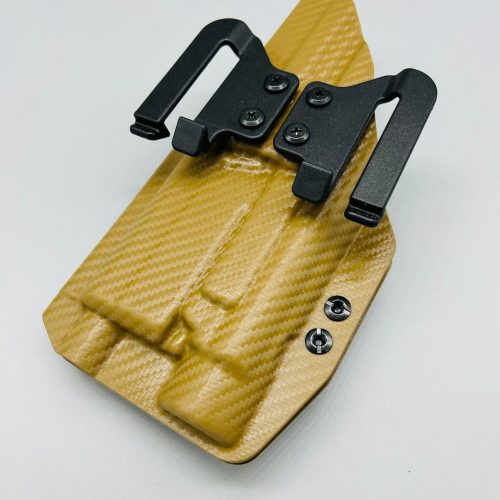
Upgrade #1: A Handmade IWB Holster for Daily Carry That Fits You, Not a Template
Your holster is the foundation. Everything else builds on it. If you only change one thing this year, make it the IWB holster for daily carry, because this is where the difference between handmade and machine-cut shows up loudest.
When we build a holster, we mold the Kydex around the actual firearm — not a digital approximation of it, not a “close enough” generic blank. That hand-molding is what creates real retention, the kind that gives you a clean, audible click on the draw and reholster and holds the gun exactly where it belongs when you’re sprinting, bending, or rolling around with your kids on the floor. We’ve written a whole breakdown on how we get that perfect retention click by hand, because it’s not luck — it’s pressure, heat, and judgment applied in the right spots.
A factory holster gets its retention from a screw you tighten down. That’s a band-aid. Crank it too tight and your draw turns into a wrestling match; leave it loose and the gun rattles. Hand-molded Kydex grips the trigger guard and the contours of the slide so the retention lives in the shape itself, not just a tension screw. A holster molded to your specific gun gives you consistent retention you can bet your life on, not a setting you have to keep readjusting.
Real example: a customer came to us carrying a compact 9mm in an off-the-shelf shell that was technically the “right” model. Problem was, the muzzle end flared open just enough that the gun shifted every time he sat down in his truck. He’d been living with it for a year. We molded him a fitted rig, and the first thing he said after a full day was that he’d genuinely forgotten it was there. That’s what custom fit does. If you want the full rundown before you order, we put together a guide on what to know before you buy a custom Kydex IWB holster that walks you through every decision.
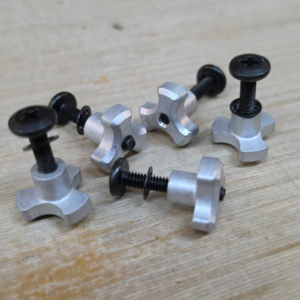
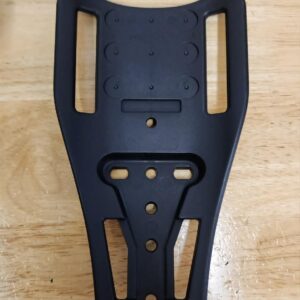
Upgrade #2: A Real Concealed Carry Belt That Doesn't Sag Under Your Rig
Here’s the upgrade nobody wants to hear about because it isn’t sexy. Your belt. A great holster bolted to a floppy department-store belt is like a race car on bicycle tires. The belt is what transfers the weight of your gun, your magazine, and your holster across your hips instead of letting it all dangle from one sad point that pulls your waistband down and out.
A proper concealed carry belt has gun belt reinforcement built in — usually a stiffener core sandwiched inside the leather or layered nylon — so it stays rigid under load. When the belt holds firm, the holster stays tight to your body, the cant stays where you set it, and the gun rides high and flat instead of flopping outward and printing. Most people who think they need a smaller gun actually just need a stiffer belt. I’ll die on that hill.
Picture a guy carrying a full-size pistol on a 1.5-inch fashion belt. By lunch the whole rig has rotated forward, the grip is jabbing his ribs, and he’s convinced appendix carry “just doesn’t work for his body.” Swap in a reinforced belt and the exact same gun and holster sit like they were glued in place. The gear didn’t change much. The support underneath it did. That’s the kind of unglamorous fix that quietly solves half the comfort complaints I hear.
Upgrade #3: Dialing In Your Appendix Carry Holster and the Accessories That Make It Disappear
Appendix carry is the most concealable position for most body types when it’s set up right — and a sweaty, printing mess when it’s not. The difference comes down to a few small attachments and adjustments that most factory holsters either skip or treat as afterthoughts. This is where we earn our keep.
The claw is a small attachment that catches on your belt and uses your own waistband to rotate the grip in toward your body. The wedge is a foam or padded piece on the backside that tilts the muzzle out and pushes the grip in even further, while killing the pressure point that digs into you when you sit. Together they’re the single best fix for printing concealment I know of, and on a hand-built rig we position them based on your body, not a one-size guess.
Cant matters too. The angle the gun sits at on your waistline changes everything about how it draws and how it hides, and proper holster cant adjustment can take a grip that’s poking out and tuck it cleanly behind your hip bone. If you’re weighing appendix against other positions, our breakdown on choosing the right holster for your carry style lays out the trade-offs without the usual internet arguing. A claw and wedge combo, properly placed, does more for concealment than dropping down a gun size ever will.
Don’t Forget the Mag
One thing daily carriers leave behind: the spare magazine. A magazine carrier upgrade that’s molded to the same standard as your holster keeps your reload flat, retained, and consistent instead of rattling loose in a pocket. If you carry the gun every day, carry the reload too, and make it ride as clean as the pistol does.
What Separates Hand-Molded Neptune Gear From the Machine-Cut Stuff
Let me put it plainly. Machine-cut holsters are made for a spreadsheet. The goal is volume — punch out as many identical units per hour as possible, at the lowest cost, fit to a generic mold that’s “good enough” for the widest slice of customers. There’s nothing evil about it. It’s just not built for you, and you can feel that the moment you wear it all day.
When I build a holster, I’m heating the Kydex by hand, pressing it around the firearm, watching how it forms around the trigger guard and the ejection port, and trimming the sweat-and-blood details that a machine never sees. Every rig that leaves here got handled by a human who’s carried a gun for real and knows what a hot spot feels like at hour fourteen. That’s not marketing fluff — it’s the actual process, and you can read more about how and why we work this way on our shop’s story page.
I’ll give you a concrete tell. Pick up a hand-molded holster and look at the definition around the slide and the trigger guard. The lines are crisp because the material was formed against the real gun under real pressure. A machine-cut shell molded to a generic master tends to look softer and more rounded, with extra clearance baked in so it’ll sort of fit variations of the same model. That clearance is the enemy of retention and concealment both. If you want to see the range of what we build, our current models and fit options show exactly which firearms we hand-mold for.
Does it cost more and take longer than grabbing something off a shelf? Yes. You’re paying for a person to build a thing to your spec rather than pulling number 4,000 off a conveyor. For a piece of gear you stake your safety on and wear every waking hour, that trade is one of the easiest calls you’ll ever make.
Lock In Your Upgrades Before Your Next Carry Day
You don’t need to overhaul everything at once. Start with the holster, because that’s the foundation everything else sits on. Add the reinforced belt next so the whole rig has something stiff to ride on. Then dial in the claw, wedge, and cant for appendix work, and bring your spare mag carrier up to the same standard. Do it in that order and you’ll feel the improvement at every step instead of guessing what fixed what.
The carriers who stick with it every single day aren’t more disciplined than you. They just stopped fighting gear that was built for an average instead of a person. Comfortable all-day carry isn’t a myth and it isn’t reserved for guys with tiny guns — it’s what happens when your holster, belt, and accessories actually fit you and work together.
If you’re not sure where to start or which setup suits your gun and body, reach out and we’ll walk you through it straight — no upsell games. You can get in touch with us here and tell us what you carry and how you carry it. Your life isn’t a machine-cut afterthought, so quit carrying like it is. Get the gear built by hand, by someone who’s been there, and make your next carry day the one where you finally forget the gun’s even on you.