
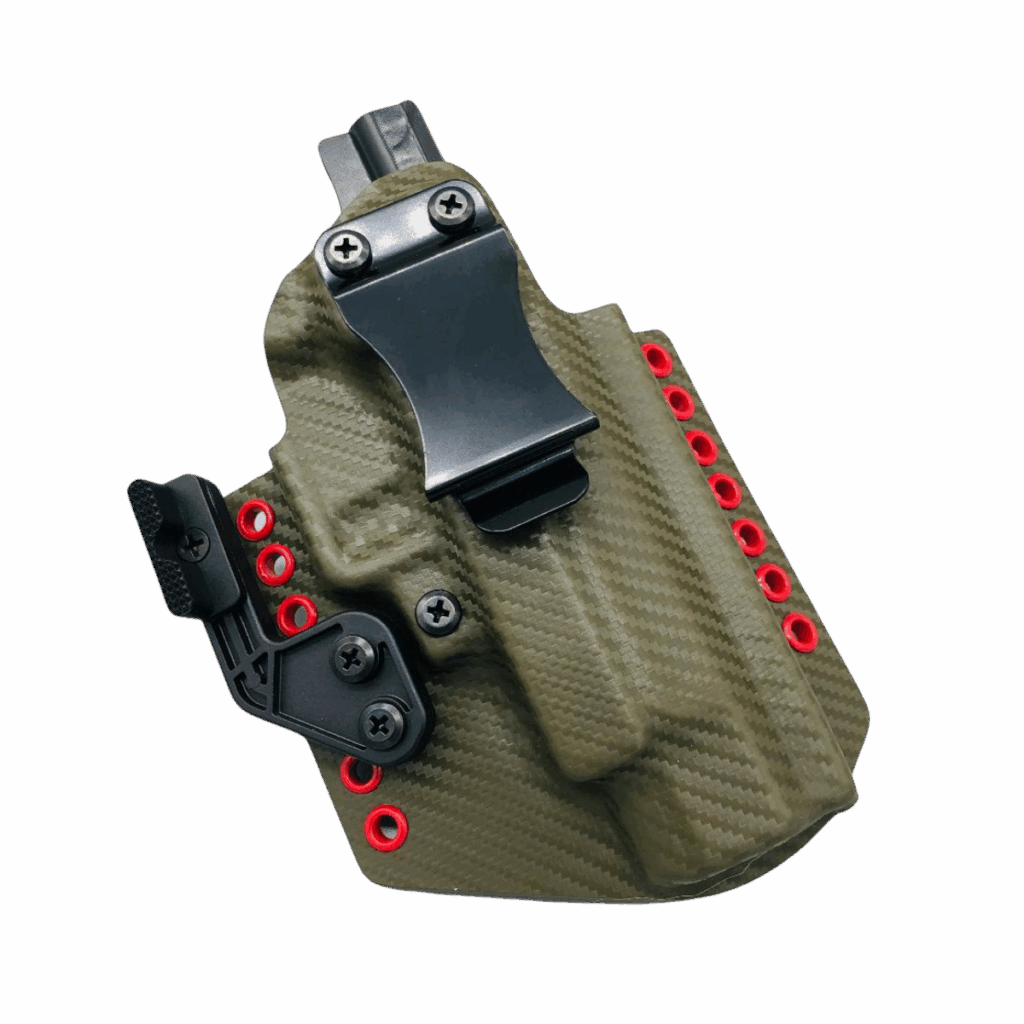
Every Neptune Concealment holster is built in your choice of solid Kydex, carbon fiber texture, or a printed pattern, and that choice is purely cosmetic. It changes nothing about fit, retention, or how the gun comes out of the shell. Solid colors and carbon fiber textures come standard with the holster. Printed patterns carry a small upcharge because the pattern is infused into the Kydex sheet before the shell is ever pressed, so it is part of the material rather than a wrap applied over the top.
Most folks spend an hour deciding between appendix and strongside, then pick a color in about four seconds. Then the holster shows up and they wish they had thought about it. I have had people order black because it felt like the safe answer, and come back six months later for something with a little personality once they realized nobody was ever going to see it anyway.
So here is the honest guide to picking a finish: what the options actually are, what changes when you pick one, and what does not change at all.
Color, Carbon Fiber, or Print: What You Are Actually Choosing
There are three separate decisions hiding inside the finish question, and people run them together.
Solid color is exactly what it sounds like. One flat color, all the way through the sheet. Scratch it and the scratch is the same color as the holster, which is the quiet advantage nobody mentions. A solid black holster that has been carried hard for two years looks worn. It does not look damaged.
Carbon fiber texture is a Kydex sheet with a woven carbon look pressed into the surface. It is not structural carbon fiber and it does not make the holster stronger. What it does is break up the surface so fine scratches and holster wear scatter instead of catching the light in one spot. If you want a holster that still looks sharp after a year of daily carry without going full black, the carbon fiber options are the practical pick.
Printed patterns are infused into the sheet. The pattern is driven into the surface layer of the Kydex, not stuck on, so it does not peel, bubble, or lift at the edges the way a vinyl wrap does. That matters at the mouth of the holster, which is the single highest-wear spot on any rig and where a surface-applied graphic would fail first.
You pick one of these. You do not stack a print on top of a color — the print is the sheet.
Does a Bright Holster Blow Your Cover?
Short answer: no, and this is the question I get most.
Printing — the bad kind, where your gun shows through your shirt — is a function of shape, not color. It is the grip corner pushing out, the muzzle end tenting the fabric, the holster sitting too far out from your body. A neon holster and a black holster with identical geometry print identically, because what you are seeing through the shirt is a silhouette, not a color.
Where color actually matters is the moment your cover garment fails. You reach for a top shelf, the wind catches your shirt, you bend over a shopping cart. In that one second, a black holster against a dark belt and dark pants reads as nothing. A bright pink one reads as something.
How much that matters depends entirely on where you carry and who is around. Plenty of people run loud colors on an inside-the-waistband rig for years with no issue, because a shirt that lifts for half a second is not a lineup. If you work somewhere that a flash of color would start a conversation you do not want, carry dark. If not, pick whatever makes you happy — the holster is going to live against your body, in the dark, under a shirt, for the rest of its life.
Outside the waistband is a different calculation. An OWB holster worn openly is visible by design, so the color is part of how the whole rig reads. That is where people tend to get deliberate about matching.
How Prints and Colors Actually Wear
Here is what two years of carry does to a holster, in order of what you will notice.
The mouth goes first. Every single reholster drags the slide across that edge, and no finish survives that forever. On a solid color you get a polished line. On a print you eventually get the pattern thinning at that contact point. This is normal, it is not a defect, and it happens to every holster ever made regardless of who built it.
The body panel is next, and it depends almost entirely on your belt and your shirt. A holster that rides against a stiff gun belt all day picks up a burnished patch where the clip sits.
Everything else basically stays put. The parts of the holster that are not touching the gun or the belt look close to new for a very long time, which is why a well-chosen print still looks good years in.
If you want a finish that ages invisibly, carbon fiber texture and mid-tone solids are the most forgiving. High-contrast patterns show wear soonest, simply because there is more going on for your eye to compare against.
Duty, Training, and the Colors That Mean Something
A few colors in the lineup are not aesthetic choices at all.
Safety orange is the training convention. A bright orange holster paired with a blue gun or a dedicated training pistol makes it obvious across a room that the rig is not a live setup. If you run force-on-force or instruct, you already know why this exists.
Police blue, firefighter red, and infantry green get picked for exactly the reason you would guess. They are department and unit colors, and they show up on duty rigs where the holster is worn openly and the whole kit is meant to read as a uniform.
If you carry concealed and none of that applies, ignore this section entirely. It is relevant to maybe one customer in ten.
Dual Color and Dual Layer Builds
Some holsters in the lineup are built from two plates rather than one, which opens up a second color choice. A dual color build lets you run one color on the outside and a different one on the inside, so the holster reads one way when it is on your belt and another way when it is off.
Two approaches work well and one does not.
Matching a bright inner plate to a dark outer plate gives you a holster that disappears in use but has some character when you handle it. Running a dark outer with a dark inner in a different texture — black against black carbon fiber, say — gives you something subtle that only you will ever notice.
What does not work is two loud colors fighting each other. The holster is a small object with a lot of hardware on it, and two high-saturation colors on one shell tends to read as busy rather than custom.
Your Screen Is Lying to You About the Color
This one is worth saying plainly, because it is the most common source of mild disappointment.
Kydex is a sheet product, and sheet products vary between production runs. On top of that, the swatch you are looking at was photographed under one set of lights, processed by one camera, and is being displayed on your screen with its own brightness, color temperature, and whatever night mode setting you forgot you turned on. By the time a color reaches your eye it has been through four translations.
Appearance, texture, pattern placement, and coloration may vary from what you see on the page. On printed patterns this shows up as pattern placement most often: because every shell is pressed individually from a flat sheet, the part of the pattern that lands on the front of your holster is not identical to the one in the photo. That is a property of making things one at a time, not a flaw.
If you are trying to match a holster to a specific piece of gear and the match needs to be exact, say so when you order and we will talk it through before anything gets pressed.
How to Pick Yours
The finish options live right on the product page. Choose your holster first, then your firearm and hand, and the design choices come up as part of the same form: solid Kydex and carbon fiber under one option, infused prints under the other.
If you want a starting point, this is the advice I give in the shop:
- Carrying concealed every day and you want to stop thinking about it? Black or a dark carbon fiber texture.
- Carrying concealed but you want the holster to be yours? Any print you like. Nobody is going to see it, and it will hold up the same as plain black.
- Wearing it openly? Pick deliberately, and think about the rest of the kit.
- Training or departmental use? The convention colors exist for a reason.
Browse the full lineup on the holsters page, or start with the Triton Series IWB if you want the most popular everyday carry shell in the catalog.
Frequently Asked Questions About Kydex Colors and Prints
Does the color or print change how the holster fits?
No. Fit and retention come from the mold and the hand-boning, not the finish. A printed shell and a plain black shell for the same firearm are pressed on the same tooling and tuned to the same retention.
Do holster prints peel or wear off?
They do not peel, because the pattern is infused into the Kydex rather than applied on top. What does happen over years of carry is thinning at the mouth of the holster where the slide drags on every reholster. That is normal wear and it affects solid colors the same way.
Does a bright colored holster make it easier to spot that I am carrying?
Only in the moment your cover garment lifts, and only if someone is looking right then. The thing that actually gives away a concealed gun is the shape pressing through your shirt, and shape is identical regardless of color.
Is carbon fiber Kydex stronger than regular Kydex?
No. It is a texture pressed into the surface of the same material. The practical benefit is cosmetic — the woven surface hides scuffs and holster wear better than a flat finish.
Can I put a print on one side and a color on the other?
On a dual color or dual layer holster you choose a finish for each plate, so a print on the outside with a solid color on the inside is possible. On a single-plate holster the whole shell is one sheet, so it is one finish.
Will my holster look exactly like the picture?
Close, but not identical. Every shell is pressed one at a time from flat sheet, so pattern placement shifts from holster to holster, and screens reproduce color differently from the material in your hand.
Can I order a color I saw on your social media that is not on the product page?
Ask. The orderable list on the product page is the current one, and material availability changes. If you have seen something you want, send a message before you order rather than after.
Does a printed holster cost more than a plain one?
Yes, there is a small upcharge for an infused print. Solid colors and carbon fiber textures are included with the holster. The current price shows on the product page when you select the option.